Mr. Trash Wheel sits at the mouth of the Jones Falls in Baltimore’s Inner Harbor, powered by the river current and by solar panels, pulling debris out of the water before it reaches the Chesapeake Bay. It is operated by the Waterfront Partnership of Baltimore as part of the city’s Healthy Harbor initiative. It has become a minor civic celebrity. It has also become a teaching device several thousand miles from Baltimore.
Coco Coders, an online coding school founded in 2016 by Elizabeth Tweedale, uses the machine as the anchor for an ocean conservation module, built from publicly available information about how the device works. Students do not start with plastic pollution as a topic to discuss. They start with an engineered response to it, examine how the response works, and then build a game or simulation modelling their own.
“It’s saying, here was a problem, here was the solution. Now, what’s your idea?” Tweedale said.
The pedagogical claim is specific. Abstract environmental teaching produces students who can describe a problem and see no role for themselves inside it. Anchoring on a real machine converts the same lesson into engineering, and the child moves from observer to designer without anyone announcing the shift.
That reframing is the point of the wider curriculum. A student who likes animals may not know that a regional shelter network runs on scheduling software, or that automated feeding systems are somebody’s job. Making the technical layer visible turns an interest into a path.
The evidence that this needs doing early is not in dispute. The OECD reported in 2020 that the career aspirations of seven-year-olds are already shaped by gender stereotypes and social background, and shift little by seventeen. A 2018 study by Education and Employers, which surveyed over 20,000 primary school children, found under one percent had learned about their chosen job from someone visiting their school.
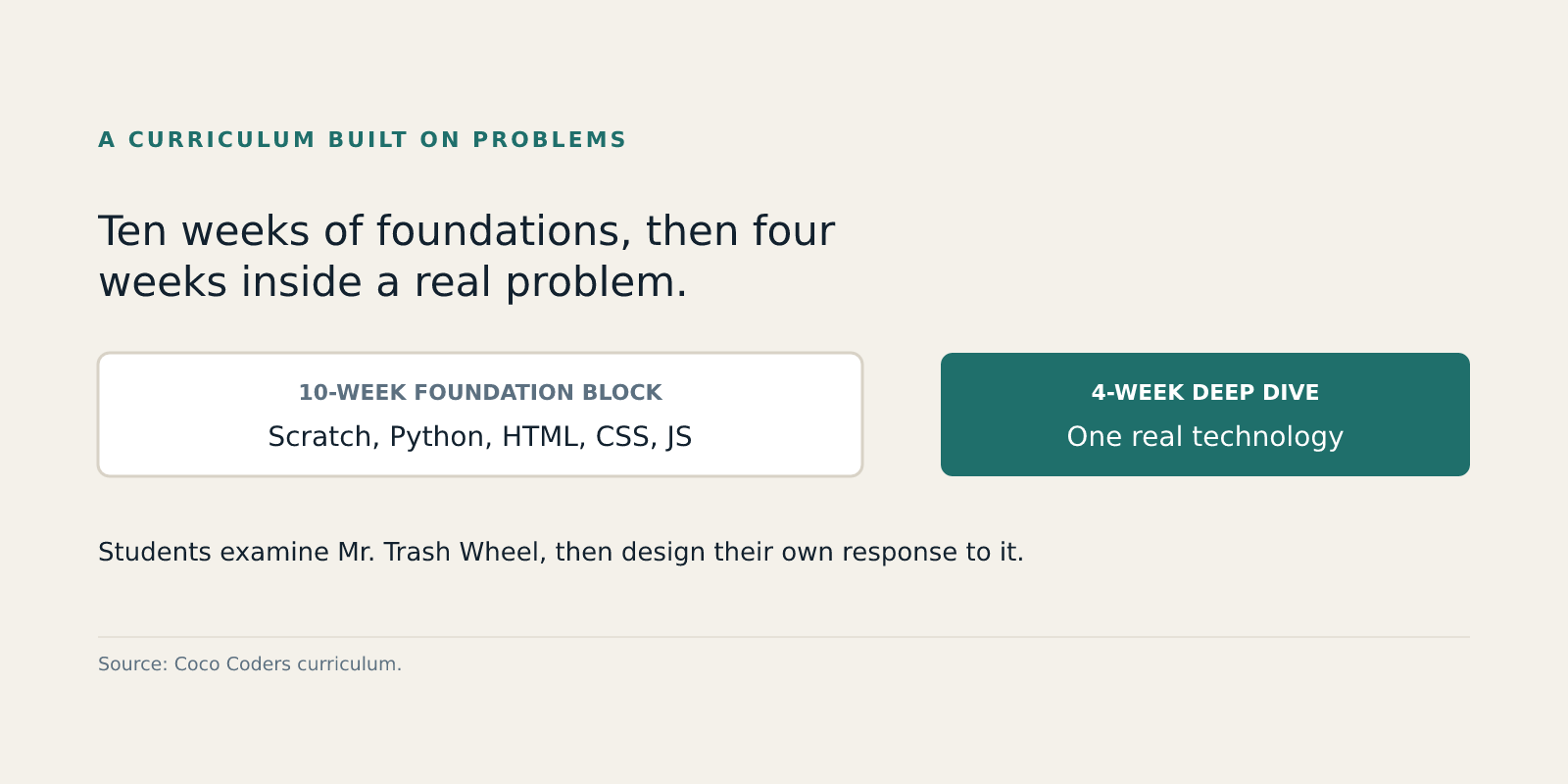
Coco Coders structures its programme as ten-week foundation blocks followed by four-week deep dives, of which the ocean module is one. Classes run live online for school-age children, covering Scratch, Python, HTML, CSS and JavaScript.
Module details are published at cococoders.com.
About Coco Coders
Coco Coders is an online coding school founded in 2016 by Elizabeth Tweedale. It teaches Scratch, Python, HTML, CSS and JavaScript to school-age children through live interactive classes in group and private formats, and works with students in the United States, the United Kingdom and internationally. Course information is published at cococoders.com.